
Dialing Within Kansas
Start with the phone code that decides whether a call connects at all. In the 620 and 785 regions, a local call needs all ten digits, and it has since October 24, 2021. In 316 and 913, the state regulator still lists seven-digit local dialing as valid. That means the exact same seven digits behave differently depending on which part of Kansas you are standing in. Anyone who moves from Wichita to Hays notices this within a day.
| Call type | Phone code format | Example |
|---|---|---|
| Local call in 620 or 785 | Ten digits, area code included | 785-296-0111 |
| Local call in 316 or 913 | Seven digits still accepted | 296-0111 |
| Long distance inside the country | 1 plus ten digits | 1-620-365-1400 |
| Toll-free | 1 plus a toll-free prefix plus seven digits | 1-800-922-5330 |
| International from Kansas | 011 plus the country code plus the number | 011-44-... |
| Service call | Three-digit N11 phone code | 211 |
The practical habit that avoids all of this is storing every Kansas number with its area code. A ten-digit entry dials correctly from all four regions and from out of state, while a seven-digit entry only works in half the state. The geography behind the four codes is laid out on the Kansas area codes page.
N11 Service Phone Codes in Kansas
N11 codes are the three-digit shortcuts, and Kansas uses most of them. What each one actually reaches is worth knowing, because two of these route somewhere very different than people assume. There is no statewide 311 line in Kansas, and 611 never reaches a state office at all.
| N11 phone code | What it reaches in Kansas |
|---|---|
| 211 | Community services and referrals, run by regional United Way partners with a statewide resource database behind them |
| 311 | Nothing statewide. Only a handful of Kansas cities operate a service-request line, so check with your own city hall |
| 411 | Directory assistance provided by your carrier, usually with a per-call charge |
| 511 | Road conditions and travel information from the state transportation department, also reachable at 866-511-5368 |
| 611 | Your own phone company, not any Kansas agency |
| 711 | Telecommunications relay service for callers who are deaf, hard of hearing, or have a speech disability |
| 811 | Kansas 811, the locate center that notifies utilities before you dig |
| 911 | Emergency response, routed through more than 100 answering centers statewide |
| 988 | Suicide and Crisis Lifeline, live nationally since July 16, 2022 |
988 deserves a footnote in Kansas that it does not get elsewhere. Both 620 and 785 already used 988 as a local exchange prefix before the crisis line existed. A seven-digit call beginning with those digits would have been ambiguous, so those two regions had to move to ten-digit local dialing first. That is the single reason Kansas ended up with two different dialing rules, and it explains why the change landed in 2021 rather than being tied to any shortage of numbers.
The 811 Phone Code and Kansas Digging
811 gets more use in Kansas than in most states, and the reason is farm and utility work. Kansas 811 is the notification center for the whole state. Dialing the code, or calling 800-344-7233, files a locate request. The center then tells every utility with buried lines near the work site to come mark them. One call covers all of them, which is the whole point of the code existing.
The Kansas 811 locate request page explains how the call is routed and what the operator will ask for.
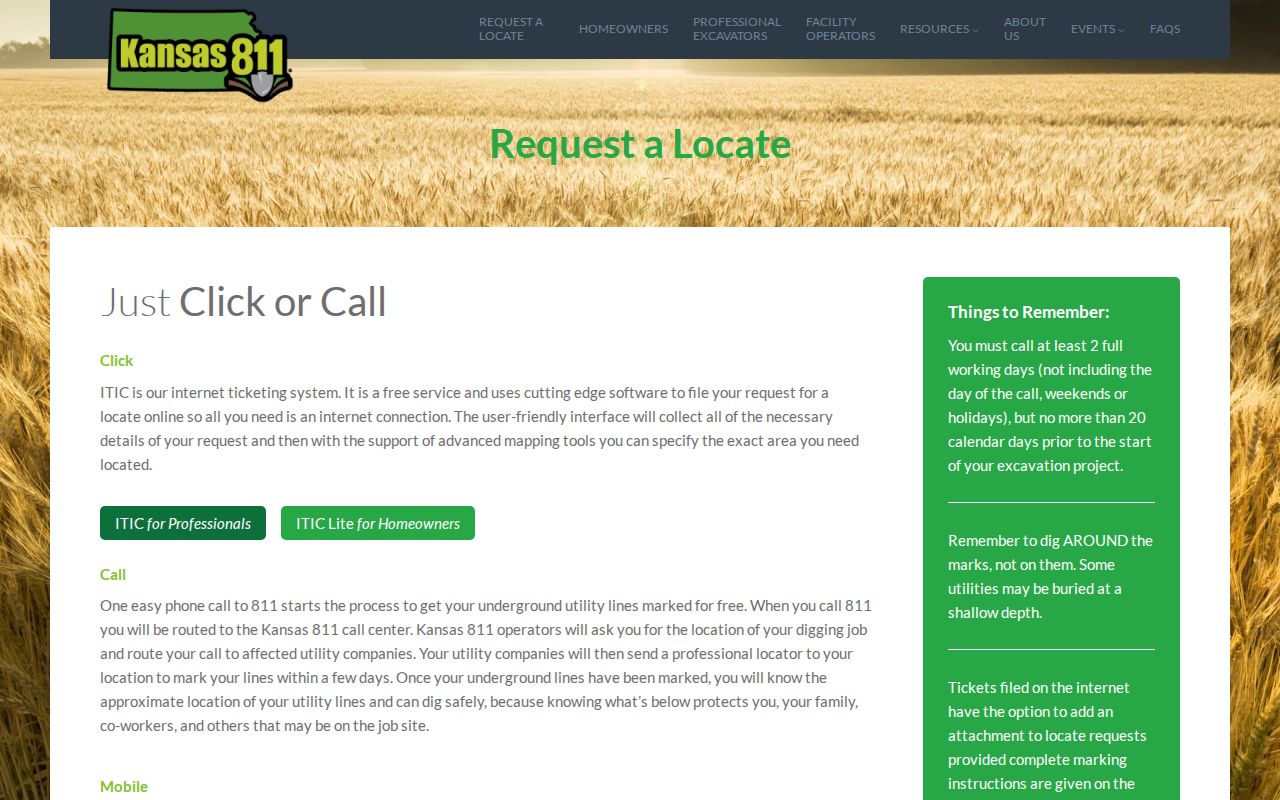
The timing rule is specific and easy to get wrong. Contact the center at least two full business days before excavating, and not more than 20 calendar days before work starts. Filing too early is as much of a problem as filing too late, because marks fade and tickets expire.
Contractors who file often skip the phone code entirely and use the online ticket portal instead.
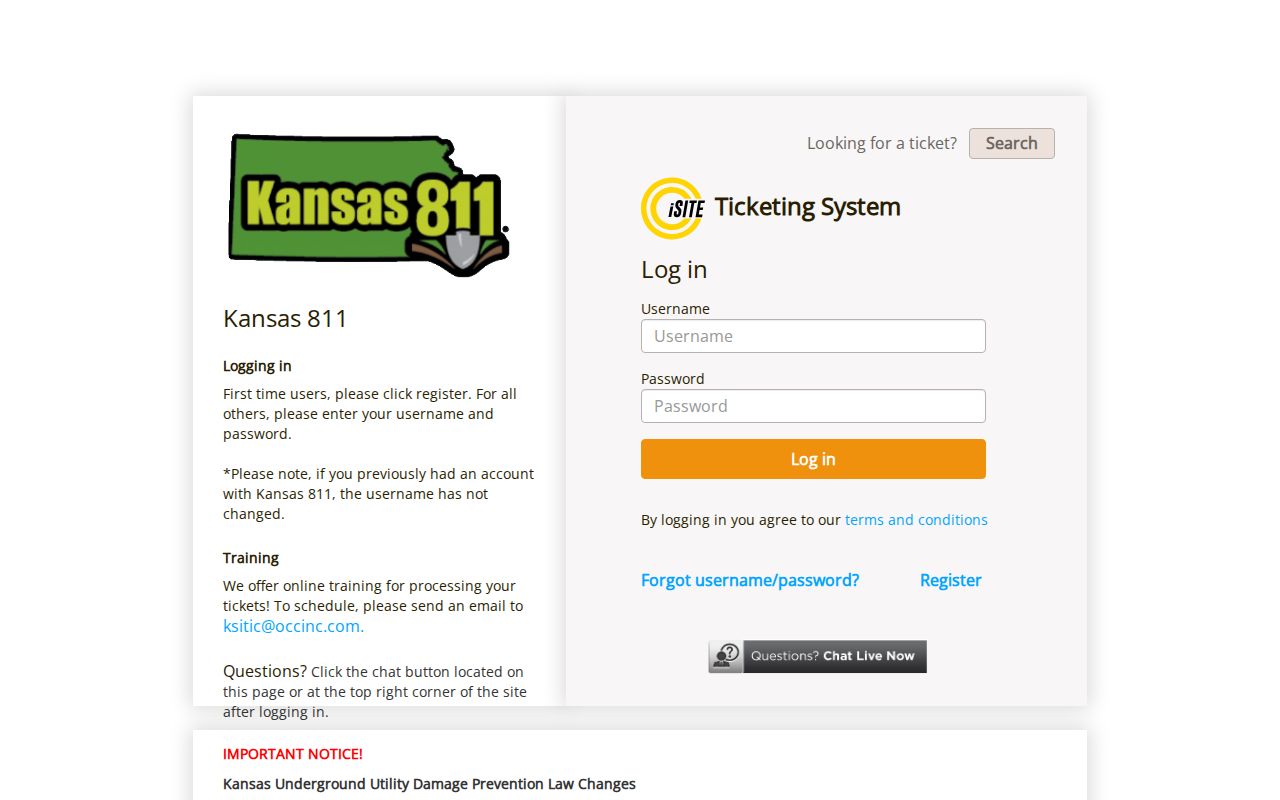
Submitting a ticket there requires an account, though the ticket search form is open to anyone and can be filtered by ticket number, street, cross street, city, county, contact name, or the type of work. Questions about a ticket already filed go to the Kansas 811 office in Wichita at 316-687-2102.
Star Phone Codes on Kansas Lines
Star codes are the phone codes that talk to your own line rather than to another person. Dial one before the number and it changes how that single call behaves. Support depends on the carrier. Traditional landlines handle nearly all of them, mobile and internet lines handle some, and a few do nothing at all on modern equipment.
| Star phone code | What it does |
|---|---|
| *57 | Traces the last call, with the result held for law enforcement rather than shown to you |
| *60 | Blocks specific numbers from calling the line |
| *67 | Hides your caller ID for the next call only |
| *69 | Returns the last incoming call |
| *70 | Turns off call waiting for one call |
| *72 | Turns on call forwarding, then asks for the forwarding number |
| *73 | Cancels call forwarding |
| *77 | Rejects calls that arrive with no caller ID |
| *82 | Shows your caller ID for the next call on a line that normally blocks it |
| *86 | Reaches voicemail on many carriers |
Two of these come up in scam warnings. Call forwarding activation is a favorite trick, since a caller who talks someone into dialing *72 and then a number can quietly send that person's calls somewhere else. Call trace has the opposite problem. It works, but the result goes to law enforcement rather than back to the caller, so it only helps as part of a report. Kansas also has two star codes of its own for highway problems. *47 reaches the Highway Patrol about a hazard or a dangerous driver, and *KTA, which dials as *582, covers the Kansas Turnpike.
The Area Phone Codes Serving Kansas
Area codes are phone codes too, just longer-lived ones. Kansas has four, none of them overlapping, and each covers a real region rather than a carrier or a service. Two arrived with the original 1947 numbering plan and two were split off from those later.
- 316 - Wichita and the immediate metro, in service since 1947
- 620 - southern Kansas outside Wichita, split from 316 in 2001
- 785 - northern and western Kansas including Topeka, split from 913 in 1997
- 913 - the Kansas side of the Kansas City metro, in service since 1947
No overlay code sits on top of any Kansas region, so these four are the whole set. County-level coverage, split history, and the current exhaust forecasts are covered in more depth on the Kansas phone area codes page.
Toll-Free Phone Codes
Toll-free codes look like area codes but carry no geography at all. The called party pays instead of the caller, which is why agencies and companies use them for statewide lines. Kansans see them constantly, from the state portal's 800 line to the child protection hotline. Each new prefix arrived because the previous one filled up.
| Toll-free phone code | Rolled out |
|---|---|
| 800 | 1967, the original |
| 888 | 1996 |
| 877 | 1998 |
| 866 | 2000 |
| 855 | 2010 |
| 844 | 2013 |
| 833 | 2017 |
One more range is worth knowing about from the other direction. The 900 range and the older 976 services are premium rate, meaning the caller is billed by the minute. Most carriers will block them on request. A toll-free code also proves nothing about who is calling, since anyone can lease one, and scam operations do.
Country Code 1 and International Phone Codes
Kansas sits inside the North American Numbering Plan, so its country code is 1. That code covers the United States, Canada, and roughly two dozen territories, which is why a call to Toronto uses the same pattern as a call to Topeka. Calling anywhere outside that group needs a different set of phone codes.
- From a Kansas landline calling abroad, dial 011, then the country code, then the local number.
- From a mobile phone in Kansas, press and hold zero to get a plus sign, then the country code, then the number.
- Calling a Kansas number from another country, dial that country's exit code, then 1, then the ten-digit Kansas number.
- Calling Canada or another plan member from Kansas, dial 1 and the ten digits, exactly like a domestic long-distance call.
The plus-sign method is the safer habit for anyone who travels, since it works from any country without needing to know the local exit code.
Local Exchange Phone Codes in Kansas
The three digits after the area code have their own name. Telephone people call them NXX codes or central office codes, and each block was originally assigned to a switching office covering one billing area. Several Kansas prefixes are recognizable enough that residents read them on sight. State offices in Topeka cluster on 785-296. The University of Kansas uses 785-864 in Lawrence, Kansas State uses 785-532 in Manhattan, and the KU medical campus uses 913-588.
Those patterns are hints, not proof. Portability lets a subscriber carry a number through a carrier change, and pooling splits a single prefix among several providers in the same billing area. A wireless or internet line can hold a Kansas prefix while the user lives two time zones away. Free prefix lookup tools report the original assignment, which is useful history and nothing more. When identity matters, the number published by the real office is the only thing worth trusting.
Spam Labels and Caller ID Authentication
The label that appears above an incoming number is not a phone code, but it comes from the same system. Carriers now sign outgoing calls to show the caller ID has not been faked, a framework the FCC calls caller ID authentication. Analytics engines use that signature, plus complaint volume and calling patterns, to decide whether to print Spam Risk or Likely Spam on the screen. A verified call is not automatically a safe one, since a scammer who legitimately controls a number passes the check. Legitimate callers get mislabeled too, which is why some Kansas clinics and schools warn families that their outgoing calls may show a warning.
Cutting the volume down starts with the national Do Not Call registry.
Registration is free and permanent, and once a number is on the list, legitimate sales callers have to stop while the ones who ignore it can be reported. Complaints about spoofing go to the FCC, and Kansas consumers can also file with the state Attorney General at 800-432-2310. Carrier apps handle the labeling side on the handset. The reporting walkthrough sits on the Kansas phone numbers page.
Phone Code Definitions
A few terms show up any time phone codes are discussed, and none of them are as complicated as they sound.
- NPA
- Numbering Plan Area, the formal name for a three-digit area code.
- NXX
- The central office code, meaning the three digits between the area code and the last four.
- N11
- The nine three-digit service codes: 211, 311, 411, 511, 611, 711, 811, 911, and 988.
- Vertical service code
- A star followed by two digits that changes how one call is handled.
- Toll-free prefix
- A code that shifts the cost of the call from the caller to the person being called.
- NANP
- The North American Numbering Plan, the country code 1 region that Kansas belongs to.
Note: Star code support varies by carrier and by line type, so a code that works on a Kansas landline may do nothing on a mobile or internet line.
How to Check a Kansas Phone Code
Verifying a phone code is quick and free. For an area code, the numbering administrator publishes maps and a searchable database. For a dialing question specific to Kansas, the state regulator's fact sheet settles which regions need ten digits. For a general consumer explanation of how the numbering system works, the FCC keeps a plain-language reference.
FCC Numbering Reference
Federal Communications Commission
Area codes and caller ID authentication
One caution applies to all of them. These sources confirm what a phone code means and where it applies. None of them identifies the person behind a specific number, and no phone code proves a caller is who they say they are.